
01
What good assessment does
Assessment should give enough evidence to judge knowledge, skills and behaviours against the required criteria without unnecessary burden.
Strong assessment is clear, fair, valid and manageable. This guide helps providers design assessment that produces better evidence and remains credible in the age of AI.
Training providers, assessors, IQAs, curriculum leads, qualification managers and education teams that need stronger assessment design and clearer evidence trails.
Assessment should give enough evidence to judge knowledge, skills and behaviours against the required criteria without unnecessary burden.
Validity means the assessment actually checks what it claims to check. A written task should not be the only evidence for a practical skill.
AI can generate written responses quickly, so providers need assessment designs that include discussion, performance, context, questioning and evidence checking.
These principles make the guide easier to apply in real settings because they connect knowledge to decisions, habits and quality checks.
Map every task to clear outcomes and remove anything that does not support a judgement.
Combine written work, observation, professional discussion, questioning, products and workplace records.
Ask learners to explain decisions, apply context and discuss their own work.
Give assessors templates, question banks, judgement guidance and examples of sufficient evidence.
Quality assurance should review design before delivery, not only after issues appear.
Evidence records should be clear enough for learners, assessors, IQAs and external reviewers.
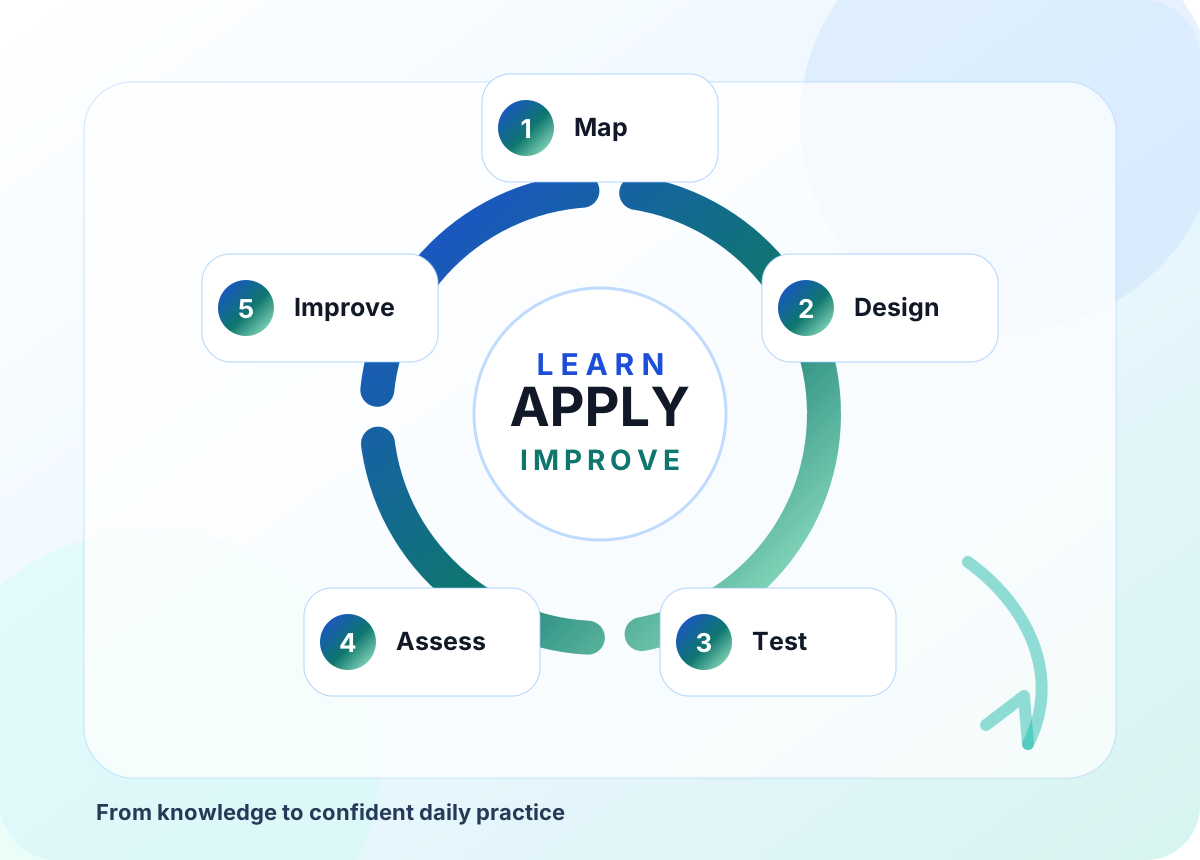
Use this flow as a practical route from first understanding to confident action, review and improvement.
Link each criterion to the most suitable evidence type.
Create tasks, questions, observations and discussion prompts.
Check if the task is clear, valid, accessible and manageable.
Collect evidence and record professional judgement clearly.
Use IQA findings and learner outcomes to refine the design.
These examples are deliberately practical so teams can connect the guide to real conversations, real learners, real customers and real quality expectations.
A learner submits a written plan. The assessor then asks scenario questions to check why choices were made and how the learner would respond if conditions changed.
The important habit is to use the knowledge with review, context and a clear professional decision rather than treating a tool, template or checklist as the final answer.
A workplace task is observed using a structured template. The record captures what happened, why it meets the criteria and what questions were asked afterwards.
The important habit is to use the knowledge with review, context and a clear professional decision rather than treating a tool, template or checklist as the final answer.
Instead of asking only for a generic essay, the task asks learners to apply policy to a workplace scenario, explain trade-offs and discuss their own evidence.
The important habit is to use the knowledge with review, context and a clear professional decision rather than treating a tool, template or checklist as the final answer.
Choose two or three actions first. Once those become normal practice, add the next layer. Sustainable improvement is better than a rushed rollout.
Good implementation is usually about clear judgement, consistent routines and knowing when to slow down.
Creating tasks that look impressive but do not clearly map to criteria.
Over-relying on written assignments when practical evidence is needed.
Adding AI rules without redesigning assessment methods.
Leaving assessors to interpret evidence standards differently.
HHF Training can support assessment design, qualification mapping, evidence tracking, professional discussion templates, observation records, IQA systems and AI-resilient assessment strategies.
Speak with HHF Training about AI training, cyber safety, CPD, assessment design, quality assurance or digital transformation support.